Practical
The useful bits
Trains, bikes, beds, oysters and tides — the things you’ll want to know before you arrive and will otherwise learn the hard way.
01
Getting there
The fastest way in is the TGV from Paris Montparnasse. There is no airport worth the name inside the region; La Rochelle has a small one with seasonal flights from the UK and a handful of European cities, and Bordeaux has everything else.
| From | To | Time | Notes |
|---|---|---|---|
| Paris | La Rochelle | 2h 40 | Direct TGV, several daily |
| Paris | Niort | 2h 10 | For the Marais poitevin |
| Paris | Surgères | 2h 20 | Change here for Rochefort |
| Bordeaux | Saintes | 1h 10 | TER, roughly hourly |
| Bordeaux | Royan | 1h 50 | Change at Saintes |
Times are typical, not guaranteed. Book TGVs early; TER fares are fixed and can be bought on the day.
02
Getting around
03
Where to stay
A short and deliberately unexhaustive list. Prices are for a double room in high season.
| Where | Place | From |
|---|---|---|
| Saintes | Hôtel des Arènes — twelve rooms in a merchant’s house near the amphitheatre; breakfast in the garden | €98 |
| Saintes | La Maison du Pont — chambres d’hôtes on the river, three rooms, run by a retired gabarier | €85 |
| Rochefort | Hôtel de la Corderie — big, old-fashioned, at the edge of the arsenal gardens | €120 |
| Brouage | Le Logis du Gouverneur — two rooms inside the walls. Book far ahead | €110 |
| Oléron | Les Claires, Château-d’Oléron — modest, clean, five minutes from the harbour | €90 |
| Coulon | Au Marais — on the quay, rooms over the water, boats from the door | €105 |
| Cognac | Domaine de la Brisée — a working distillery with four rooms above the chai | €140 |
There are campsites all along the coast and on both islands. Most close from November to March.
04
Eating & drinking
Lunch is the main meal and is served from noon until about 1.45, after which you will struggle. Most restaurants offer a fixed menu du jour at lunch for €16–24 that is better value than anything on the evening card.
05
Tides
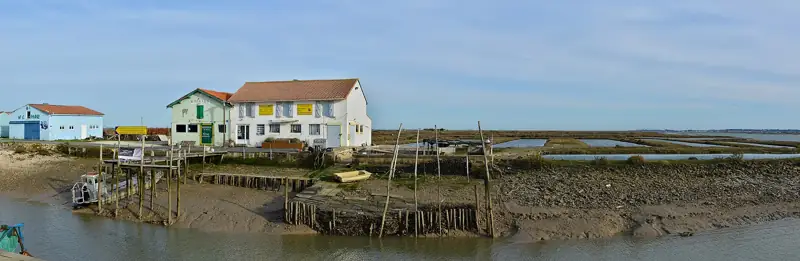
The tidal range on this coast is large — over six metres at spring tides — and it governs more than you’d think: when the oyster farmers work, when the birds feed, when the ferry to Aix can dock, and whether the beach you chose is a beach or a kilometre of mud.
Tide tables (horaires des marées) are posted in every tourist office and most bars. Read them for the nearest port: La Rochelle–La Pallice for the north, Île d’Aix for the Charente estuary, Royan for the Gironde.
Never walk out onto the mud flats on a rising tide, and never alone. The sea comes in faster than a person walks, and the channels fill first, behind you.
06
A few manners
Say bonjour when you walk into a shop, a bakery, a bar, a waiting room. Not saying it is noticed.
Village shops and many restaurants close on Monday, and sometimes on Sunday evening too. Pharmacies and bakeries take turns staying open; the rota is pinned to the door.
The oyster claires and salt pans are private, working land. Stick to the paths and leave the gates as you found them.